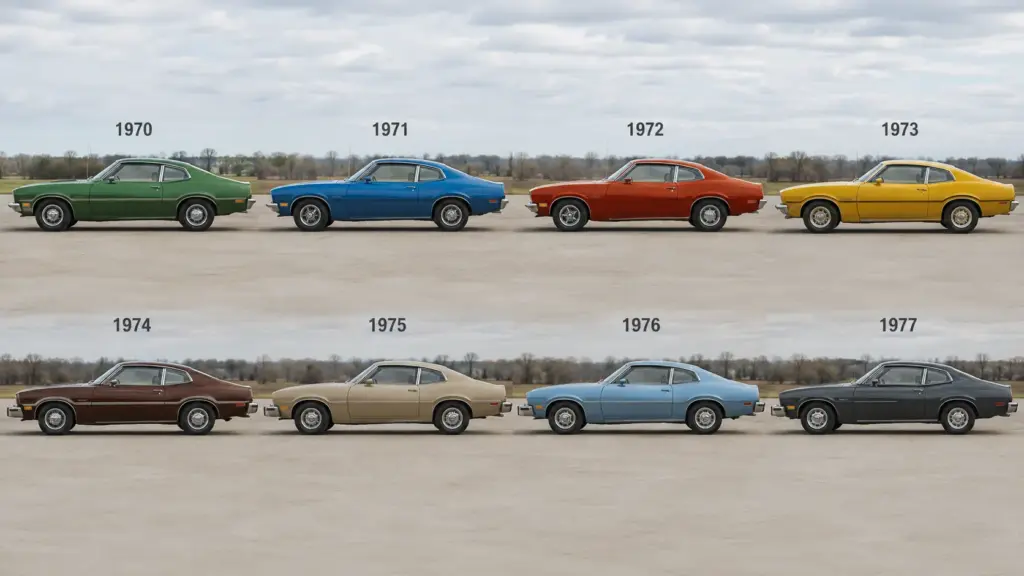
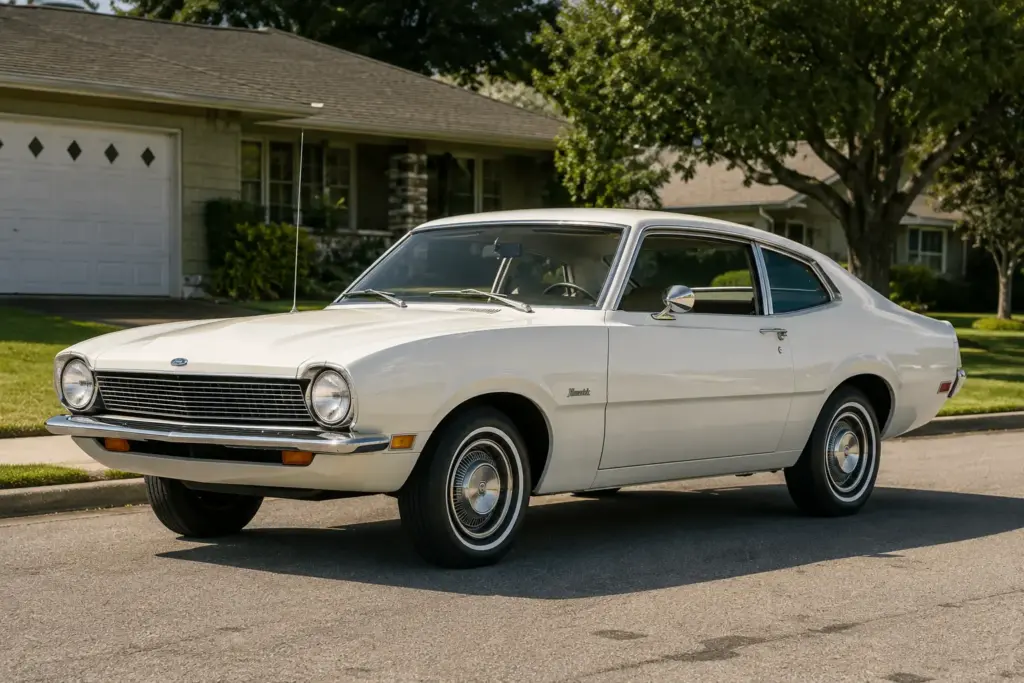
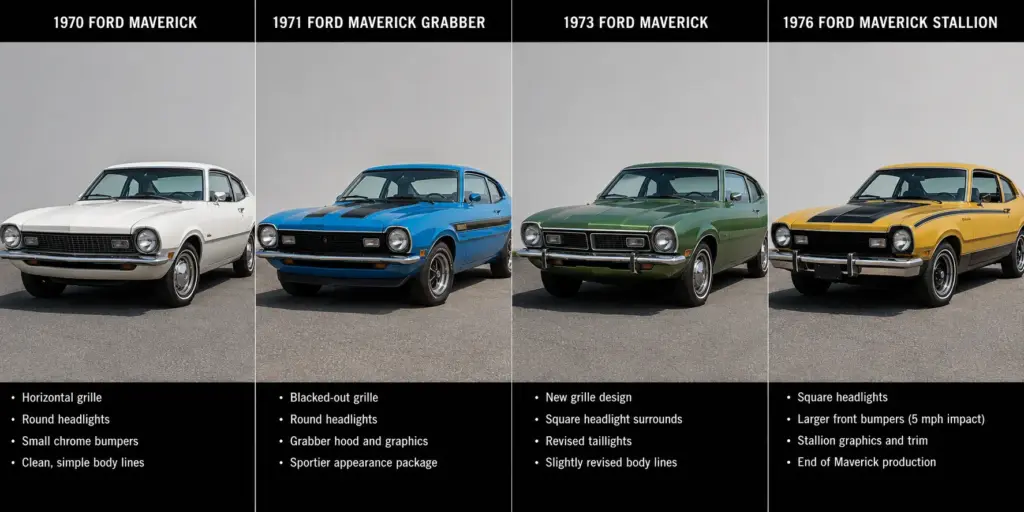
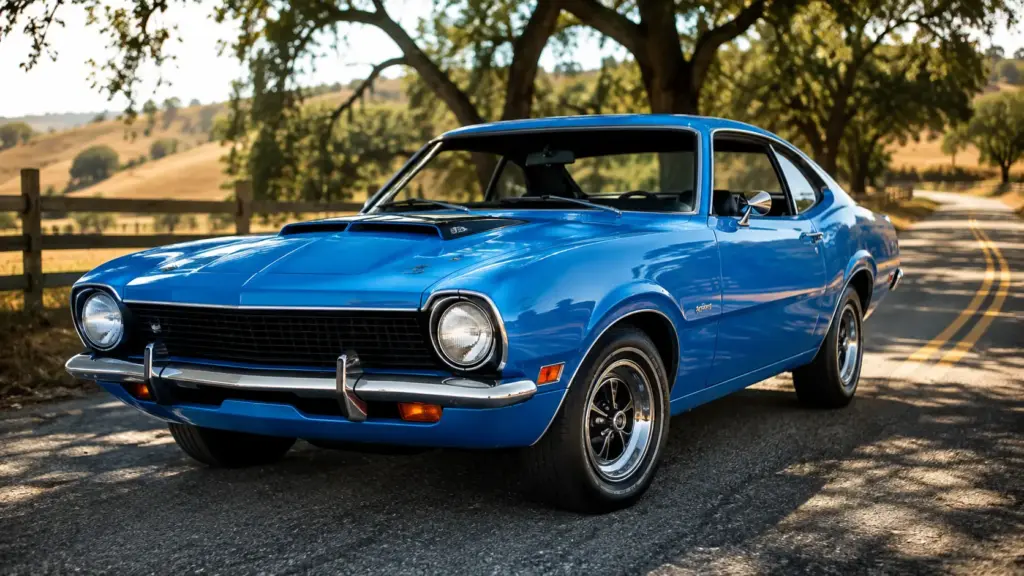
Ford Maverick Model Year Changes are one of the most important things to understand before buying or restoring a classic Maverick. Although the car’s overall design remained familiar throughout its production from 1970 to 1977, Ford introduced new engines, trim packages, safety upgrades, and styling revisions almost every year.
If you’ve ever shopped for a classic Ford Maverick, you’ve probably noticed that no two model years are exactly alike. At first glance, a 1970 Maverick and a 1977 Maverick may appear nearly identical, but look a little closer and you’ll find meaningful differences in styling, engines, trim packages, safety equipment, and overall driving experience.
Some changes were driven by customer demand. Others were the result of new federal safety and emissions regulations. A few were Ford’s attempts to keep the Maverick competitive in a rapidly changing automotive market.
Understanding these year-by-year differences can save you from buying the wrong project car, help you identify rare factory options, and even increase the value of your restoration.
In this guide, we’ll walk through every model year from the Maverick’s debut in 1970 to its final production year in 1977 highlighting what changed, what stayed the same, and which models collectors value most today.
Ford Maverick Model Year Changes (1970–1977)
Before diving into each year, this overview highlights the most important Ford Maverick Model Year Changes introduced between 1970 and 1977.
Model Year
Biggest Change
Best Known For
1970
First production year
Affordable compact with clean styling
1971
Four-door body and 302 V8
Most desirable early model
1972
LDO luxury package
More comfort and trim choices
1973
Front disc brakes and fuel crisis
Increased popularity
1974
Larger safety bumpers
New federal safety standards
1975
Minor updates
Mature, refined model
1976
Stallion package
Sporty appearance package
1977
Final production year
Last chance to buy a new Maverick
If you’re looking for the classic chrome-bumper look, most enthusiasts agree that the 1970–1973 models offer the cleanest styling. Later cars remain excellent drivers but have larger impact bumpers that noticeably change the Maverick’s appearance.
Understanding these Ford Maverick Model Year Changes makes it much easier to identify the right model for your budget, restoration goals, or collection.
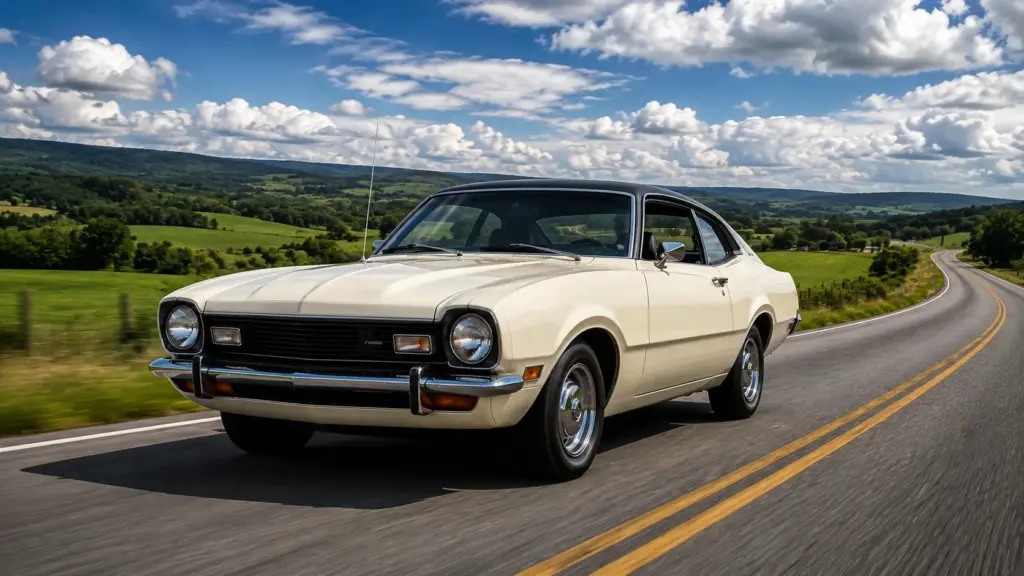
1970 Ford Maverick: The Beginning of a Success Story
When Ford introduced the Maverick in April 1969 as a 1970 model, the company wasn’t trying to build another Mustang. Instead, it wanted an affordable compact car that could compete with imported brands such as Volkswagen, Toyota, and Datsun.
The Maverick was intentionally simple. Buyers wanted dependable transportation at a reasonable price, and Ford delivered exactly that.
Starting at just $1,995, the Maverick quickly became one of the best values on the American market.
What Made the 1970 Maverick Different?
The first-year Maverick featured a clean, uncluttered design that has aged remarkably well.
Key features included:
Slim chrome front and rear bumpers
Two-door sedan body style
Distinctive long hood and short rear deck
Round headlights with a black grille
Simple interior focused on functionality
Rear-wheel-drive platform based on proven Falcon engineering
Unlike many larger American cars of the era, the Maverick didn’t overwhelm buyers with unnecessary luxury features. Its straightforward design also made it easier and less expensive to maintain.
Today, that simplicity is one reason restorers enjoy working on early Mavericks.
Engine Options
The standard engine was Ford’s dependable 170 cubic-inch inline-six, paired with a three-speed manual transmission. Buyers looking for more power could later choose the optional 200 cubic-inch inline-six, which provided better acceleration while maintaining respectable fuel economy for the time.
Although these engines won’t win drag races, they’re known for durability and smooth operation. Many original examples are still running today with surprisingly few major modifications.
Collector’s Perspective
First-year production models always attract attention, and the Maverick is no exception.
Collectors appreciate the 1970 model because it represents the purest version of Ford’s original design. It lacks the heavier bumpers and emissions equipment that appeared later in the decade, giving it a lighter, cleaner look.
Finding an unmodified 1970 Maverick has become increasingly difficult, especially one that hasn’t suffered from rust or extensive aftermarket changes.
Best For
Collectors seeking originality
Stock restorations
Weekend cruiser projects
Vintage Ford enthusiasts
Did You Know?
Ford reportedly received more than 200,000 orders for the Maverick shortly after its introduction. The overwhelming demand surprised even Ford executives and confirmed that American buyers were ready for a practical compact car.
1971 Ford Maverick: The Year Many Enthusiasts Want
If you spend time talking with Maverick owners at car shows, one model year comes up again and again: 1971.
Many longtime enthusiasts consider the 1971 Maverick the sweet spot of the entire production run. It kept the clean styling of the original while adding features that broadened the car’s appeal.
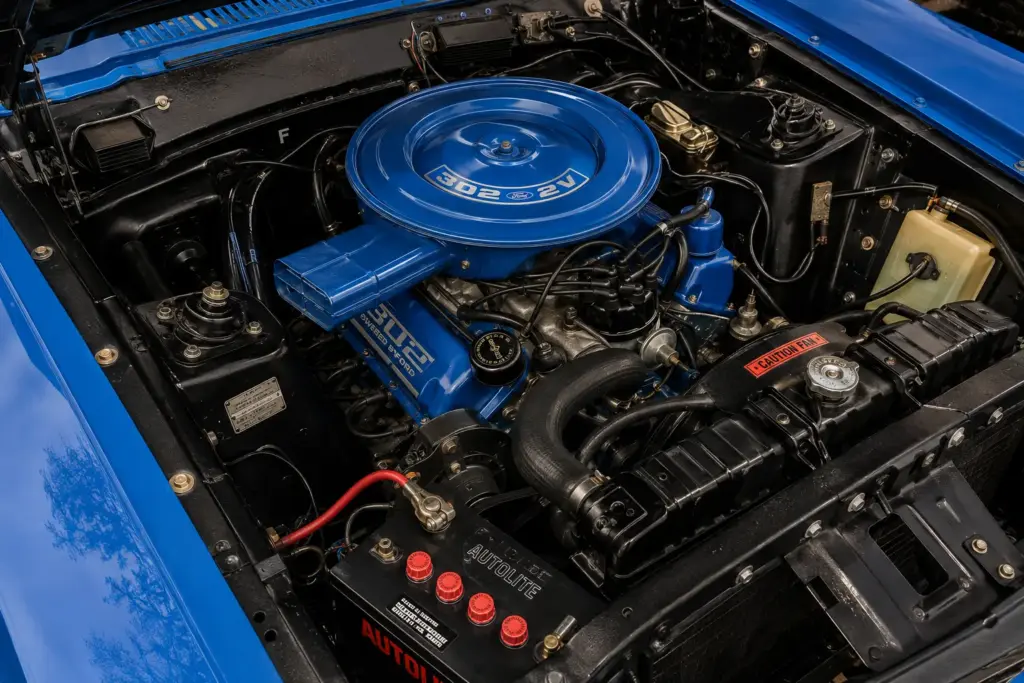
Most importantly, Ford introduced the 302 Windsor V8, transforming the Maverick from a simple economy car into a surprisingly lively compact.
Major Changes for 1971
Ford made several important updates for the second production year.
Four-Door Body Style
For the first time, buyers could order a four-door Maverick.
While today’s collectors generally prefer the sporty two-door models, the four-door appealed to families who wanted a practical daily driver with compact dimensions.
Optional 302 Windsor V8
This was easily the biggest mechanical upgrade in Maverick history.
The optional 302 V8 gave the lightweight Maverick noticeably stronger acceleration and transformed its personality.
Even by modern standards, a well-tuned 302-powered Maverick feels surprisingly responsive thanks to its relatively light weight.
Today, original factory V8 cars are among the most desirable Mavericks on the collector market.
Improved Equipment Choices
Ford also expanded the option list by offering:
Additional exterior colors
More wheel choices
Interior trim upgrades
Convenience options
Enhanced comfort packages
These changes made the Maverick attractive to a much wider audience than simply budget-conscious buyers.
Why Collectors Love the 1971 Model
Ask ten Maverick enthusiasts to name the best production year, and there’s a good chance several will answer 1971.
Here’s why:
Early chrome bumpers
Classic body styling
Factory 302 V8 availability
Grabber package compatibility
Excellent parts availability
Strong aftermarket support
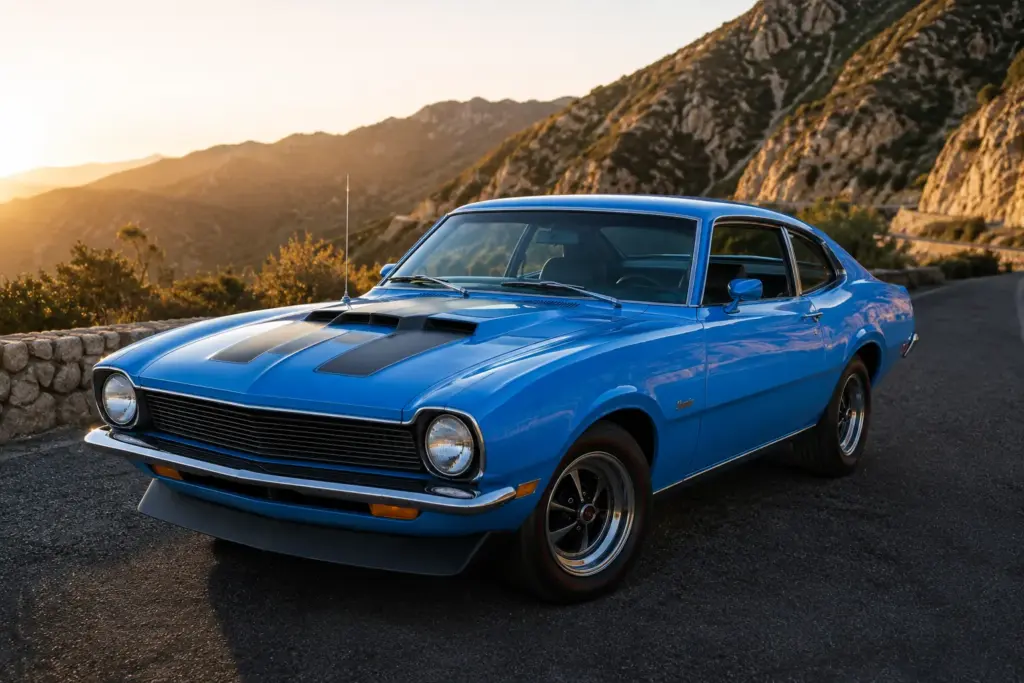
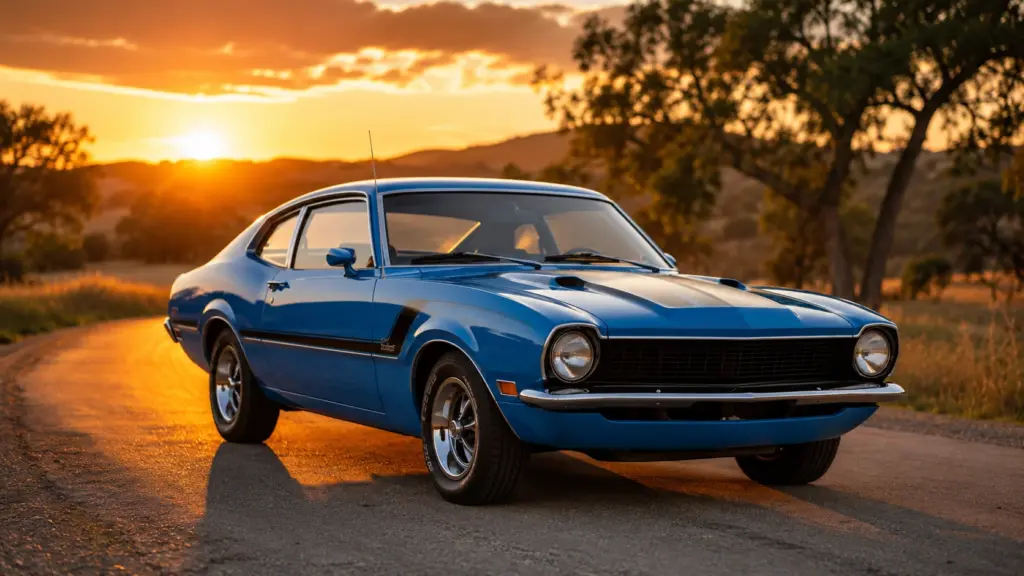
It’s no surprise that the 1971 Ford Maverick Grabber remains one of the most sought-after versions today.
Buying Tip
If you’re shopping for a 1971 Maverick, don’t assume every car advertised as a “302 V8” left the factory that way.
Many six-cylinder Mavericks have been converted over the years because the engine swap is relatively straightforward.
Always verify the VIN, engine codes, and supporting documentation if originality is important to you.
1970 vs. 1971 Ford Maverick
Feature
1970
1971
Body Styles
Two-door only
Two-door and four-door
Standard Engine
170 I6
170 I6
Optional V8
No
Yes (302 Windsor)
Collector Demand
High
Very High
Restoration Difficulty
Moderate
Moderate
1972 Ford Maverick: More Comfort, More Choice
By 1972, the Ford Maverick had already proven itself as a sales success. Instead of making major mechanical changes, Ford focused on giving buyers more choices. Whether someone wanted an economical commuter or a more upscale compact, there was now a Maverick to suit their needs.
This was the year the Maverick started appealing to a broader audience, especially buyers who wanted a smaller car without giving up comfort.
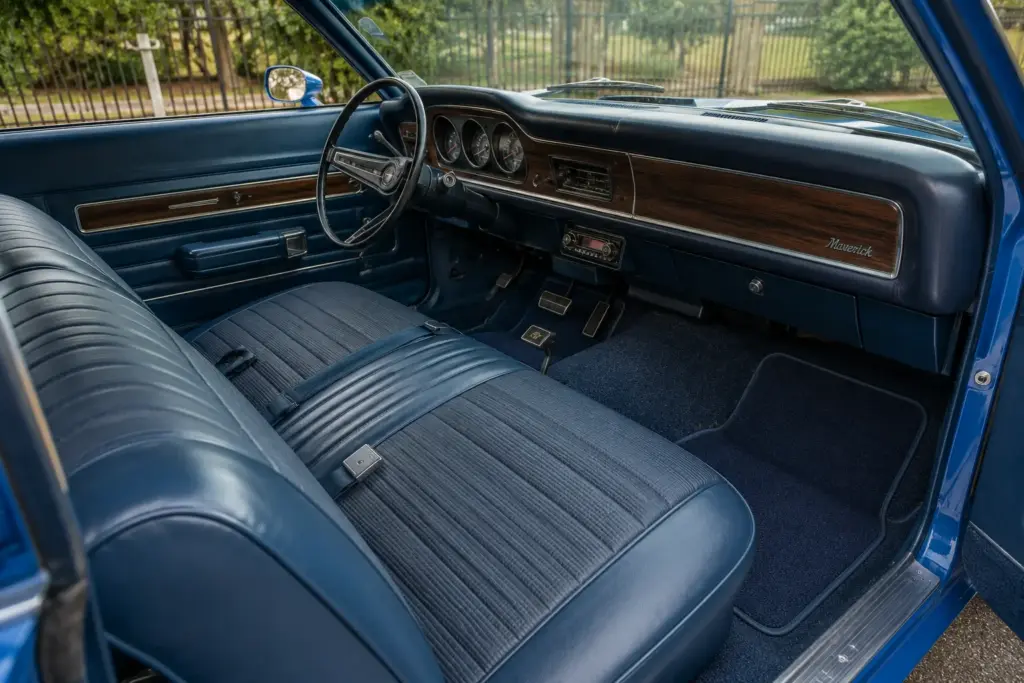
Luxury Decor Option (LDO)
One of the biggest additions for 1972 was the Luxury Decor Option, better known as the LDO.
Today, many enthusiasts overlook the LDO because the Grabber gets most of the attention. However, if you’ve ever sat inside a well-preserved LDO, you’ll quickly understand why it was popular.
Instead of emphasizing sporty styling, Ford focused on making the Maverick feel more refined.
LDO Features Included
Plush cloth or vinyl seating
Woodgrain dashboard accents
Additional chrome trim
Upgraded carpeting
Higher-quality door panels
Vinyl roof on many examples
Extra sound insulation
The LDO wasn’t intended to compete with luxury cars, but compared to a standard Maverick, it offered a noticeably more comfortable driving experience.
The Sprint Edition
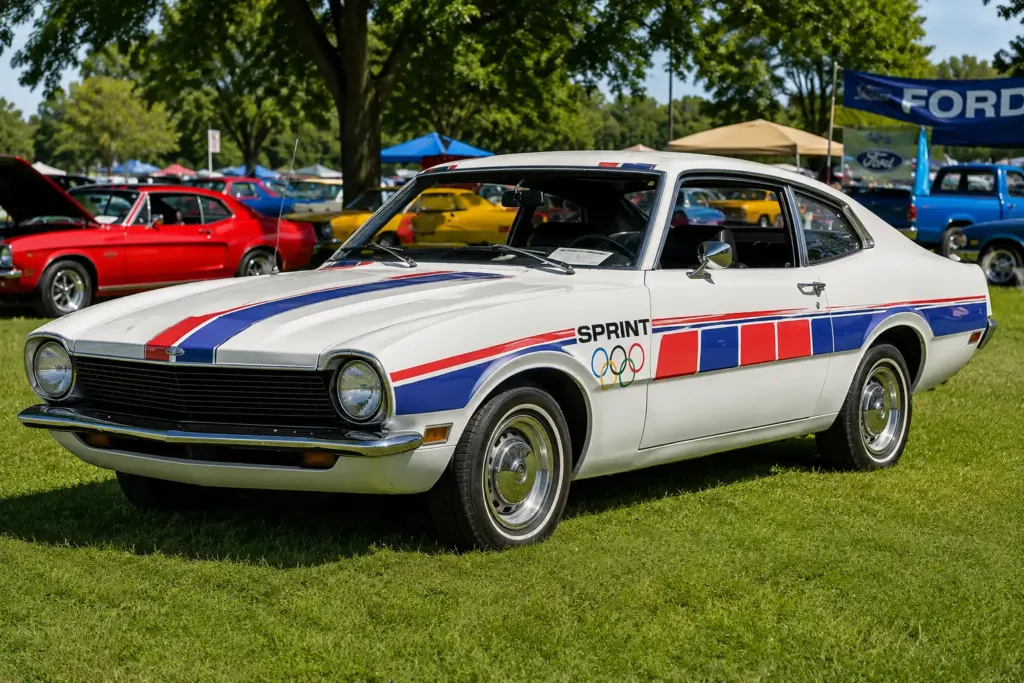
Another interesting addition in 1972 was the Sprint Package, introduced to celebrate the Olympic Games.
Although it wasn’t produced in large numbers, the Sprint has become one of the more recognizable special editions today.
Typical features included:
Red, white, and blue exterior graphics
Unique wheel covers
Special interior trim
Patriotic appearance package
Because relatively few survived, original Sprint cars attract considerable attention at Ford shows.
Engine Choices Remained Familiar
Ford continued offering the dependable engines buyers already trusted.
Engine
Horsepower (Approx.)
Best For
170 Inline-6
Economy-focused
Daily driving
200 Inline-6
Balanced performance
Most buyers
250 Inline-6
Better torque
Highway driving
302 Windsor V8
Performance
Enthusiasts
Although emissions regulations gradually reduced horsepower across the industry, the 302 V8 still provided plenty of enjoyable performance in the lightweight Maverick.
Collector’s Perspective
The 1972 model often represents excellent value.
Because many collectors concentrate on 1970 or 1971 cars, nice 1972 examples can sometimes be purchased for less while offering nearly identical styling.
If originality matters more than maximum resale value, a clean 1972 Maverick deserves serious consideration.
Buying Tip
When inspecting a 1972 LDO, pay close attention to:
Vinyl roof condition
Interior trim pieces
Woodgrain dashboard
Seat upholstery
Door panels
Mechanical parts are generally easy to replace, but original LDO interior components can be much harder to find.
1973 Ford Maverick: The Right Car at the Right Time
Sometimes a car becomes successful because of circumstances beyond the manufacturer’s control.
That’s exactly what happened in 1973.
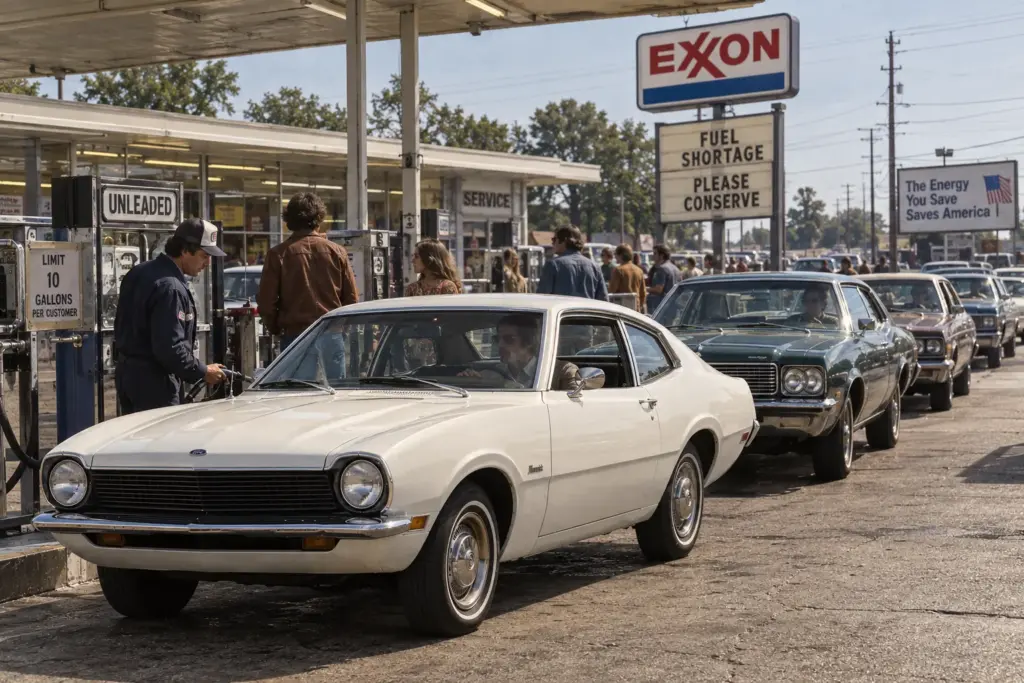
The global oil crisis changed the American automotive market almost overnight. Suddenly, fuel economy mattered far more than horsepower.
While owners of large V8-powered sedans struggled with rising fuel costs, Maverick owners found themselves driving one of Ford’s most practical vehicles.
Front Disc Brakes Improve Safety
One of the most important improvements for 1973 was the availability of front disc brakes.
Although drum brakes had served drivers for decades, front discs offered several advantages:
Shorter stopping distances
Better braking in wet weather
Reduced brake fade
Easier maintenance
If you’re shopping for a driver-quality Maverick today, factory disc brakes are a valuable feature.
Higher Demand During the Fuel Crisis
The fuel shortages of 1973 dramatically increased interest in compact cars.
Ford already had the Maverick in showrooms, making it perfectly positioned to meet changing consumer demand.
Buyers appreciated:
Better fuel economy
Lower purchase price
Lower maintenance costs
Proven reliability
As a result, the Maverick remained one of Ford’s strongest-selling passenger cars during this period.
Exterior Styling
Visually, the 1973 Maverick looked very similar to earlier models.
It still featured:
Slim chrome bumpers
Clean front grille
Classic body proportions
Distinctive fastback-inspired roofline
Because of this, many collectors group the 1970–1973 models together as the “early Mavericks.”
Collector’s Perspective
Many enthusiasts consider 1973 the final year of the original Maverick design.
Why?
Because 1974 introduced significantly larger federal safety bumpers that changed the car’s appearance.
If you love the original styling but also want factory front disc brakes, the 1973 model offers an excellent combination.
Did You Know?
Many classic Ford enthusiasts specifically search for 1973 Mavericks equipped with factory disc brakes and the 302 V8, as they combine improved stopping power with V8 performance while retaining the early chrome bumper design.
Early vs. Late Mavericks
One of the biggest decisions buyers face is choosing between an early or late-production Maverick.
Here’s a quick comparison.
Feature
1970–1973 Models
1974–1977 Models
Chrome Bumpers
Slim
Large safety bumpers
Appearance
Sportier
Heavier-looking
Weight
Slightly lighter
Slightly heavier
Collector Demand
Higher
Moderate
Parts Availability
Excellent
Excellent
Neither version is objectively better.
If you value originality and classic styling, an early Maverick is hard to beat.
If you simply want a reliable cruiser, a later model can be just as enjoyable while often costing less.
Which Early Model Is Best?
Let’s compare the first four production years.
Model
Best For
Overall Rating
1970
Originality
★★★★★
1971
Performance
★★★★★
1972
Comfort
★★★★☆
1973
Driving Experience
★★★★★
Before buying any classic Maverick, don’t miss our guide to Ford Maverick rust areas, which covers the most common corrosion-prone locations.
1974 Ford Maverick: Safety Regulations Change the Design
By 1974, the Ford Maverick was no longer the new kid on the block. It had earned a reputation as a dependable, affordable compact, but changing government regulations forced Ford and every other American manufacturer to rethink vehicle design.
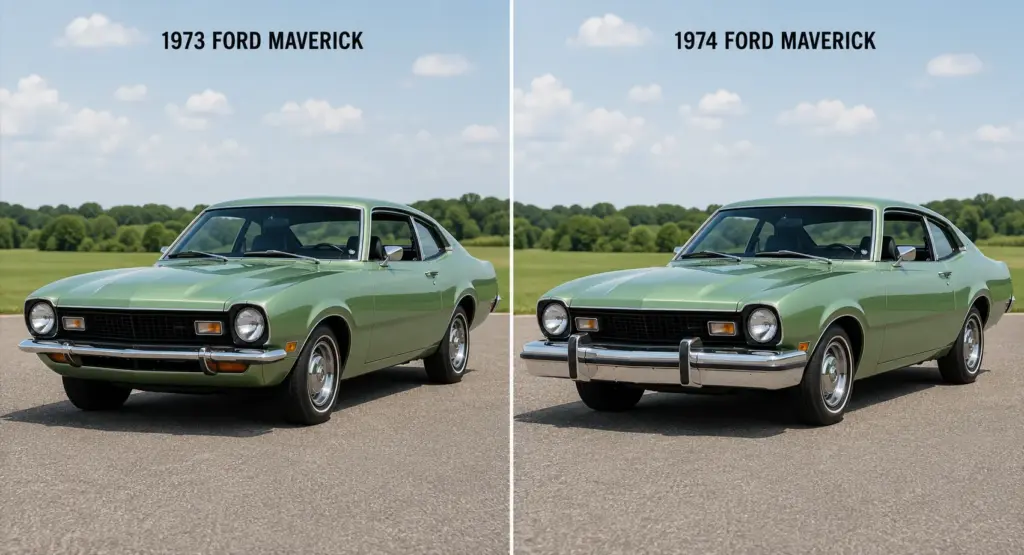
The most noticeable change came from new federal crash standards, which required stronger bumpers capable of withstanding low-speed impacts with less damage.
The result? The Maverick received much larger front and rear bumpers.
For many enthusiasts, this marks the point where the car’s appearance began to change significantly.
What’s Different About the 1974 Maverick?
If you park a 1973 Maverick beside a 1974 model, the difference is immediately obvious.
Exterior Changes
Larger front impact bumper
Larger rear bumper
Reinforced bumper mounts
Slight increase in overall weight
Minor trim revisions
Mechanically, the car remained familiar, but visually it lost some of the light, sporty character that made the early cars so appealing.
That doesn’t mean the 1974 model isn’t worth owning. It simply has a different personality.
The larger bumpers introduced for the 1974 model year were designed to comply with updated U.S. Federal Motor Vehicle Safety Standards, which required improved low-speed impact protection.
Driving Experience
Despite the added weight, the Maverick still delivered the same easy-to-drive characteristics owners appreciated.
It remained:
Comfortable around town
Simple to maintain
Easy to park
Inexpensive to repair
For many buyers in the mid-1970s, those qualities mattered far more than aggressive styling.
Collector’s Perspective
The 1974 model is often overlooked, which can actually work in a buyer’s favor.
Because demand tends to focus on the earlier chrome-bumper cars, clean 1974 examples are sometimes available at more affordable prices.
If your goal is to enjoy driving a classic Ford rather than chasing maximum resale value, the 1974 Maverick deserves a closer look.
1975 Ford Maverick: Refining a Proven Formula
Ford made relatively few changes for 1975.
Rather than reinventing the Maverick, engineers concentrated on improving reliability, emissions compliance, and overall refinement.
By now, the Maverick had become a mature product with a loyal customer base.
Notable Features
Continued availability of inline-six engines
Optional 302 Windsor V8
Minor trim revisions
Updated emissions equipment
Improved reliability through ongoing production improvements
Although Ford had introduced the Granada as a more upscale compact, the Maverick continued to attract buyers looking for straightforward, dependable transportation.
Should You Buy a 1975?
Absolutely especially if you’re looking for a weekend cruiser rather than a concours restoration.
Many 1975 Mavericks have survived because they were often treated as practical daily drivers instead of performance cars.
That means finding an unmodified example is sometimes easier than finding an early Grabber.
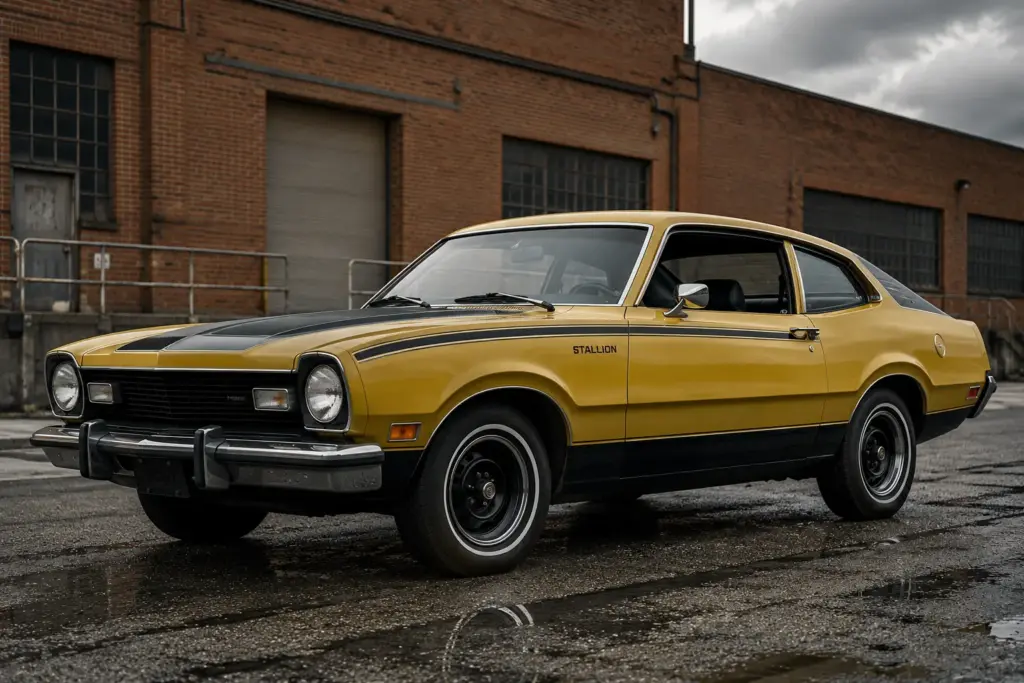
1976 Ford Maverick: Enter the Stallion
As the Maverick approached the end of its production life, Ford looked for ways to keep the lineup fresh.
One of the most interesting additions was the Stallion Package.
Unlike the Grabber, which emphasized sporty graphics and performance-inspired styling, the Stallion focused primarily on appearance.
Stallion Package Features
Depending on the vehicle, the package typically included:
Black exterior trim
Sport wheels
Unique striping
Black grille
Color-coordinated appearance details
Today, original Stallion cars are relatively uncommon.
Because many were simply used as everyday transportation, surviving factory examples have become increasingly desirable among collectors.
Collector’s Tip
If you’re considering a Stallion, verify that it’s a genuine factory-equipped car.
Over the years, many owners have recreated the appearance using aftermarket decals and trim.
Factory documentation adds significant value.
1977 Ford Maverick: The End of an Era
The 1977 model marked the final chapter in the Maverick story.
After eight successful model years and more than two million vehicles produced, Ford prepared to introduce an entirely new compact platform.
That replacement would become the Ford Fairmont, built on the revolutionary Fox platform.
Although production ended, the Maverick’s influence continued.
Its simple engineering, affordable ownership, and dependable mechanical components helped build a loyal enthusiast community that remains active today.
Final-Year Features
The final Mavericks largely carried over the features introduced during previous years.
Buyers could still choose:
Inline-six engines
Optional 302 V8
Two-door or four-door body styles
Automatic or manual transmissions
Ford wisely chose not to make unnecessary changes during the final production year.
Ford Maverick Model Year Changes: Which Year Is Best?
This is one of the most common questions enthusiasts ask.
The answer depends entirely on what you’re looking for.
If You Want…
Best Model Year
Original styling
1970
Best overall balance
1971
Comfortable cruising
1972
Disc brakes with early styling
1973
Lower purchase price
1974
Reliable weekend driver
1975
Rare appearance package
1976 Stallion
Final production model
1977
For most enthusiasts, the 1971 Ford Maverick remains the standout choice. It combines the clean styling of the early cars with the availability of the factory 302 Windsor V8, making it one of the most desirable models to own and restore.
Common Parts That Changed Through the Years
If you’re restoring a Maverick, understanding which components changed can save time and money.
Component
Changed During Production?
Front bumper
Yes
Rear bumper
Yes
Grille
Minor revisions
Tail lights
Minor revisions
Interior trim
Yes
Steering wheel
Yes
Dash trim
Yes
Engines
Expanded options
Suspension
Mostly unchanged
Body shell
Largely unchanged
One advantage of the Maverick is that many mechanical parts interchange across multiple years, making restoration more straightforward than with some other classic cars.
Expert Buying Advice
After decades of watching Mavericks change hands, one lesson stands out:
Buy condition first, options second.
A rust-free six-cylinder car is often a smarter purchase than a heavily rusted V8.
When inspecting a Maverick, focus on:
Shock towers
Front frame rails
Floor pans
Rocker panels
Quarter panels
Trunk floor
Cowl vents
Door bottoms
These areas are far more expensive to repair than replacing an engine or transmission.
If you’re patient, you’ll almost always find a better car than the first one you look at.
Final Thoughts
The Ford Maverick evolved steadily throughout its eight-year production run. Rather than undergoing dramatic redesigns, Ford refined the car year after year, responding to changing regulations, customer expectations, and market conditions.
That gradual evolution is part of what makes the Maverick so interesting today.
Whether you prefer the clean simplicity of the 1970 model, the V8 performance of the 1971, the comfort of the 1972 LDO, the practicality of the 1973, or the distinctive appearance of the Stallion, there’s a Maverick for nearly every type of enthusiast.
More than fifty years after its introduction, the Maverick continues to attract a growing community of owners who appreciate its honest engineering, approachable restoration costs, and unmistakable place in Ford’s history.
If you’re considering buying one, take the time to learn the differences between each model year. The more you know, the easier it will be to find the Maverick that best fits your goals and the more you’ll enjoy owning one.
Original factory brochures and technical documents available through the Ford Heritage Vault can help verify specifications, trim levels, and optional equipment for each model year.